This article was originally published in NBH – The International Journal for Bee-Centred Beekeeping, NBH28/2023. I wrote the article in spring 2023.
© Erkki Pöytäniemi
Main photo above: Our apiary in January 2019
We live in SW Finland c. 90 km west from Helsinki at 60° north. I have had bees here since 2014 and I have kept bees also earlier in life.
According to conventional wisdom we are too far north for wild honeybee populations. Of course that could be questioned but maybe the main point is that with climate change it is not relevant anymore. Just the 1,5°C global temperature increase could move us to north Poland in terms of daily temperature sums (1). The question is then not how to conserve nature as it is (we can’t) but how to help it develop into something resilient in changing conditions. Then honeybees should play a role as a key species in the temperate hemiboreal climate zones.
Our property Iso-orvokkiniitty is a 12 hectare permaculture inspired homesteading farm where we live off-grid in a strawbale-clay house and do forest gardening, shiitake cultivation and bees among other things. While designing the different projects I am working on my Diploma in Applied Permaculture Design. One of the designs in the portfolio is about bees – I call the design ”Caring for Bees”. Link to the design.
Often in permaculture design linear design frameworks like SADIMET (2) are used, but in this case I am using Looby’s Design Web (3). It is a non-linear design tool which allows for free movement of thought between 12 anchor points (Vision, Helps, Limits, Patterns, Ideas, Principles, Integration, Action, Momentum, Appreciation, Reflection and Pause). Design Web allows design of regenerative cultures and living systems where the outcome can be unpredictable. In ”Caring for Bees” I doubled the Design Web by reflecting about the anchor points both as myself and as the honeybees (I was bee’ing). Behind that reflection is a lot of reading and trying to understand the wild honeybee.

As a result of this reflection my own Vision became ”(Re)wilding bees in and around Iso-orvokkiniitty”. I listed Limits as Varroa-mites, sufficient food for overwintering, winter in general (it’s long and still pretty cold), lack of nests and genetics. Actually I think it boils down to genetics and lack of nests. Genetics and allowing natural selection to work is key because we can’t get rid of varroa and even with climate change winters are still going to be long and cold. Winters will not get shorter here because climate change will not affect day length. So we need to allow the bees to develop Varroa resistance and we need bees who have an opposite strategy towards winter than the Italian and other southern breeds we use in Finland.
Beekeepers want the bee colony to be strong for the short main nectar flow from June to early July. That means strong colonies overwintering with a lot of sugar (25-30 kg) and a relatively short break in winter brooding. This is the wrong strategy for wild honeybees in the north. The time to die of hunger is in the spring (this was the same for people up to the late 19th century in Finland). If the bees start brooding early, food stores are low and the spring is cold, there will be a problem. The European Dark bees in the north knew this and had the opposite strategy, overwintering as a relatively small colony, stop brooding early and start late and thereby avoid dying of hunger if the spring is cold and they cannot fly or there is nothing to forage. Nordic Dark Bees also fly in colder weather.
In their Design Web the Bees formed their Vision as ”Establishing ourselves – the Honeybees – in THE WILD around Iso-orvokkiniitty in Karjalohja”. I think that is a natural thing for any biological entity to want to do – to try to establish themselves where-ever they happen to be.
The bees thought they can best help themselves by swarming and also by learning how to groom, cap cells and other behaviour needed for Varroa-resistance.
They need people to help them too. They need an environment where they can thrive: diverse and fragmented natural and man-made landscapes, organic farming (no pesticides) and gardening and orchards, lake-shores etc – here we have all that. All the farmland within 2-3 km radius is organically managed. An environmental challenge to the bees is that there is a lack of late blooming plants. With warm springs and summers everything blooms even earlier than before.
Honeybees need nests which is a challenge because forests are managed and cut down young. Fortunately big aspens have often been left even in clear-cut forests and some of them are big enough. But we should also put up log hives to help.
The bees also need us to introduce genetics that would give natural selection more material to work. A natural idea is to introduce European Dark bees that presumably have adapted better to the local conditions than the imported southern breeds. The Dark Bees in Finland have gone extinct but there are a few breeders who breed Dark Bees and an association for Dark Bees (or rather the people working with them) (4). The genetics come mostly from Sweden, partly from Ireland. The early beekeepers in late 18th and 19th centuries brought the bees from Sweden anyway.
I am presuming that we don’t have free-living bees here – at least not to the degree that we could talk about a population. So in order to generate a population we also need to manage bees, i.e. be beekeepers and act as a source of swarms until a sufficient wild population is formed. For this we will employ Darwinian beekeeping (as defined by Thomas Seeley) whereby we give the bees a chance to cope with the Varroa-mite and we let natural selection work on the bees.
Finally we need the population to be bigger than what I can support on Iso-orvokkiniitty. We need to expand the area gradually around us by inspiring other people to join the effort.
So this is my plan (the Action anchor-point in the Design Web):
1. Continue keeping bees at Iso-orvokkiniitty employing Darwinian beekeeping strategies whatever the hive type (I have Top Bar Hives, Warré hives and standard Farrar wooden hives). The total number of hives here should be less than 10 so as not to exceed the natural capacity of the landscape.
2. Introduce European dark bees in the managed hives (buying queens or nukes from Dark Bee breeders). The Dark Bees will cross-breed with whatever other bees are in the surroundings but my bees should have a drone dominance due to not restricting drone brooding.
3. Place log hives on our property to provide nesting places for swarms.
4. Inspire and help others within flying distance from us and each other to do the same (Darwinian + Dark Bees + Log Hives).
5. Monitor wild bees in the area.
The Bees’ action points are swarming and trying to survive as best they can.
Ethics
This might be the place to say a few words about ethics. Permaculture is based on the three Permaculture Ethical Principles: Earth Care, People Care and Fair Share. Each design and action point should be weighed against those ethical principles. That is the wisdom part of permaculture because it makes us reflect on the wholeness the design relates to from the perspective of the different ethical principles. The Earth Care principle means that nature has an intrinsic value that we need to respect. If we for example justify our actions by ecosystem services (pollination etc) we are actually referring to instrumental (utilitarian) values which belong to the People Care principle. So People Care represents utilitarian values where People could mean myself or family or any relevant group I belong to or people in general. Fair Share is where we think about other people including future generations and how we share resources with them in a fair way.
The ”Caring for Bees” design is very much about Earth Care but People Care and Fair Share are also important because I believe that we need to save the honeybees also for our own sake. Of course the ecosystem services aspect is also there and we can even harvest some honey from the managed hives.
We also have ethical considerations on different levels of the honeybee superorganism. This design requires us to let swarms go knowing that most of them will not survive the first winter. We don’t treat for Varroa knowing that many of the colonies will therefore die. So we have chosen to focus on the species and the right of the species for natural selection and thereby survival. All ethical considerations can not be met at the same time.
The Path to Re-wilding
The way from standard mainstream beekeeping to rewilding is quite long and most beekeepers don’t step on this transformational path at all. Personally I started with organic beekeeping in wooden Farrar hives in 2014 (organic as defined in the EU organic regulation). Soon I realized that organic beekeeping was pretty much the same as mainstream beekeeping with some restrictions. The basic framework was the same. I started looking into ”Natural Beekeeping” and inspired by Philip Chandler (6) built Top Bar Hives (TBH) in 2015 and Warré hives in 2016, but still my focus was on producing honey and preventing swarming. I did sugar feeding and Varroa prevention according to Finnish standards, so the main differentiation were the hives I was using. I also held Natural Beekeeping Courses every spring.
A more profound change in my thinking started in 2020-21. I realized that the TBH and Warré hives, while better in many respects, did not offer a perfect solution for the bees. I was only half-way to somewhere else. I think reading Thomas Seeley’s ”The Lives of Bees”, learning about Torben Schiffer’s work and listening to the Arboreal Apiculture Salon podcast all had an effect and pushed me further. Finally, starting the permaculture design for bees made me analyze my thinking and what I had learned and take the logical steps towards wilding.
Implementation
August 2020 was the last time I applied any Varroa preventive measures (Standard methods in Finland are timely oxalic acid, formic acid, and thymol extract treatments and growing and cutting out drone boord.) In 2021 I built 2 ”Biboet” type log hives of wooden boards and sawdust insulation and in 2022 together with some friends we made the first real log hives. In 2022 I bought Dark Bee nukes, 5 for myself and 3 were set up nearby at friends’ properties. One of my Dark Bee hives did not survive the winter so now there are 7 Dark Bee hives in the area (within 2 km radius from us). I still also have 3 ”mixed italian” hives. And there is one colony in a nearby aspen that survived the winter. I keep the bees according to Darwinian beekeeping principles. There are a few other apiaries nearby.
My Farrar and Warré hives were all nukes last year so they all received sugar feeding in 2 boxes. In practical terms Darwinian beekeeping means limited space for the colony. In late May I add a third box underneath and that is all the space they will get. It means 84 litres in the Farrar hives and 54 litres in the Warré hives. The TBH overwinter with 10 top bars (appr. 36 litres) and get a few more top bars in May so up to 60 litres (max 15 top bars). I will overwinter the hives with 3 boxes volume and consider feeding sugar if necessary. If I didn’t feed sugar, in the spring I can check if there is any honey left for me.
Many of the colonies will swarm. If the swarm happens to be in front of me, I’ll catch it – but mostly they will find their new nest themselves. That’s why we need to put as many log hives as possible in the surrounding area. That is a big part of the project.
Closeby to us in the forest there is a big aspen tree with the trunk diameter about 80 cm. For the last 5 years I have observed swarms in a cavity about 10 meters high. I noticed the buzz while picking mushrooms. This spring (2023) was the first time I have observed the colony survive winter. Reason to celebrate! I have seen a swarm go into a cavity also in a much smaller aspen closeby 3 years ago. I now presume that aspen is the most potential tree species for bee cavities in our circumstances.
Last year we made 7 big log hives but managed to get only one of them up on 3 meter legs. So far it hasn’t been occupied. This spring on 21.5.2023 I pulled one of the log hives up into an aspen and sprayed some lemongrass extract inside. The next day scouting bees were examining it and also the previously set up log. 2 days later a swarm was in the new log hive. On the same day I caught a swarm from the leg of our storage building and put it into a Warré hive in the evening.
Experiencing the first surviving colony in the aspen and getting a swarm in our log hive the same spring feels very empowering. It is easier to go on with the project with positive feedback from the bees!
[1] Ruosteenoja, K., Markkanen, T., Räisänen J. (2020). Thermal seasons in northern Europe in projected future climate. Int J Climatol; 1-19.
[2] [Design Methods | Knowledge Base](https://knowledgebase.permaculture.org.uk/design)
[3] [The Design Web – Cultural Emergence](https://cultural-emergence.com/the-design-web/)
[4] [Suomen Tumman Mehiläisen Hoitajat – Suomen Tumman Mehiläisen Hoitajat](https://tummamehilainen.fi)
[5] Stefan Breitholtz. 2020. Biboet Bihallning till Husbehov: Lamplig inom Biodynamisk Odling och Permakultur
[6] Philip Chandler. 2007. The barefoot beekeeper.

Still in June 2020 the apiary was beside our garden and all the hives were there. Since 2021 I have spread the hives out on the property and there is only one hive on this spot. Top bar hives, Farrar hives and Warré hives. Buckets under the feet of the top bar hive: The Formica aquilonia wood ant attacks bee hives in the spring before they start farming aphids. They can mobilise an endless stream of ants that will finally kill the colony if not protected. If the hive legs are standing in water the ants will not get there.

Building 2 “Biboet” type log hives (inspired by Stefan Breitholtz (5))

Last June (2022) a swarm decided to stay under the Biboet log hive instead of going inside. I presume it was because it was a very hot week (30+C°). They were very nice Italians – I could stand just beside them without them reacting in any way. It was an ethical dilemma for us. From a Darwinian point of view they had clearly made a bad choice – they would not survive outside. Nevertheless they had entered our domain so we decided to save them into a Warré hive. Of the 7 combs 5 were brood which we cut into 2 Warré boxes. Honeycomb is too difficult to get into the box in a sensible way so we harvested it. This was 15th August and they only had 4-5 kg of honey and too late to forage more. So they would have starved even if inside the log. I fed them sugar and they overwintered well into 2023. So from a Darwinian viewpoint our decision was wrong?

We found the queen early on so we knew it was safe (plastic clip on the hive).

I had made a jig for sawing the cavities in the logs. This piece is 60 cm long – the cavity is roughly 30 litres. Rapeseed oil in the chain saw. Inside surfaces were left as they were after chainsawing.

20-25 cm slices of the same log act as top and bottom of log hive. Entrance hole in the lower end is 30 mm and a second one higher up is 16 mm (small enough that they can close it if they like).

April 2022: Figuring out how to pull the log hive up. We had 4 pieces of 6 meter long two-by-fours attached at the top and a pulley. We pulled the hive as high as we could and built the legs under it.

The first log hive set up on 3 meter legs in 2022. It hasn’t been occupied yet.

I got the log hive up into the tree with a pulley on 21.5.2023. I still need to add a roof.

I sprayed some lemongrass extract inside and in 2 days there was a swarm inside. Quite early for swarming in Finland and no idea if it was from my hives or somewhere else. Looks like the 30 mm entrance hole is crowded – maybe it should be bigger. So far they are not using the 16 mm hole on the other side.

Visiting the bee-aspen 21.4.2023 with our puppy Halti and the colony was looking very strong. The cavity is about 1 m above the lowest branch on the left – so about 10 meters high. Earlier in the spring the cleansing flight can be easily observed from yellow marks and some dead bees on the snow. The forest is heavily managed – clear-cut in the early 1990’s and thinned last year. Fortunately they save the big aspen trees and there are quite a few in the area around us. This is the biggest one but I have seen a swarm go into a much smaller one.
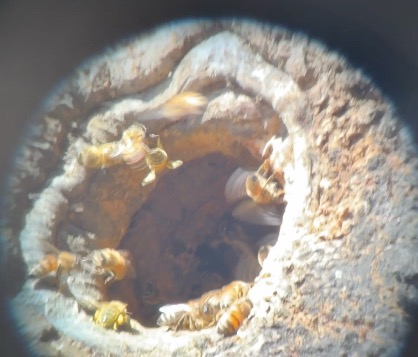
The entrance of the aspen bee nest through a telescope. April 2023.