Prelude
This article will be a little different because I think I need to tell what I planned to do and started doing but didn’t finalise. Maybe this chapter is not really a part of the design but it is a part of my design path. Anyway I am publishing it now on 5.5.2021 but I am pretty sure I will come back to it for editing.
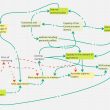
In the previous article about Planning Areas I listed for each planning area its Functions and Elements. I took all of them as post-it notes to my Miro board so that I could do a Function – Elements analysis of the whole Iso-orvokkiniitty site. You can see it here on the right side.
I tried to group the functions and elements into groups that I call Systems:
- The 1st one is the “Household” where the function is broadly speaking “Living”.
- The 2nd system is “Infrastructure” where functions relate to Storage, Energy, Water and Food. All those might as well be separate systems.
- The 3rd system is the “Garden and Cultivation” system
- Then you can see a bunch of yellow post-its that should mainly fall under the Cultivation system
- Then there is “Forest Garden” and “Forest”.
Then I started drawing connections between the different functions and elements but got the feeling that this is not working very well. There is too much details. I wasn’t seeing the forest for the trees.
Something that becomes clear is that the elements and functions in the “Household” system relate quite directly to our needs – especially our physiological and safety needs. Looking at our needs helps us to identify some of the functions and elements that are so obvious that you might forget them. Funnily there are obvious needs that are often not mentioned. If you look at the Maslow’s hierarchy of needs graphic below you might wonder why we generally have a toilet in our houses? In our case the dry toilet was the first building we made when we stayed here in our caravan. There is only so many times you want to go into the forest with a spade…

So in the first board systems are on the left, the mid column is the elements and on the right you have the functions. The lines point from the elements to the functions. The sauna is an interesting example. Mainly it points to the hygiene function but of course we have a shower so the sauna is not really necessary. So why did we invest a substantial amount of money and work to build a traditional 18 m2 stock sauna? The need that triggered us (me) to do that must be somewhere higher in the Maslow hierarchy.

So I took an other approach and started looking at Inputs and Outputs of the whole Iso-orvokkiniitty system. I made a distinction between external inputs and outputs and internal inputs and outputs. With later I mean that outputs from a subsystem are inputs for an other subsystem. That is of course an important permaculture principle falling under “Catch and Store Energy”, “Use and value renewable resources and services”, “Produce no waste” and “Integrate rather than segregate”. (1)
Again I divided the whole into systems:
- Household
- Garden & Forest Garden
- Forest
- Mobility
It was interesting to see that even though I didn’t finalise this analysis either it was clearly pointing to a partly different set of systems.
However I realised that I was again getting lost not seeing the forest for the trees. Evidently a key permaculture design principle I should use first is “Design from Patterns to Details” (1). So let’s look at the big picture first before going too much into the details. Let’s look at the Systems and their interactions.
Systems
The exercises above – even if not finalised – were useful because they helped me validate the Systems at play. From the exercise I deduced a systems analysis matrix which shows the obvious: there is much more interaction and dependency between us (our household) and society than between our household and the rest of the systems on our homestead. We are running a business that brings money home (financing) which pays for the external resources we bring in from the society. Ironically it would be possible to cut ourselves from our homestead but not from society.

If our reasoning is that society functions in an unsustainable way, then we should decrease our dependency in it and increase our self-sufficiency. However the current economical system is in fact very efficient even while it externalises a lot of real costs to nature in an unsustainable way. If our aim is to detach ourselves from that unsustainable model and increase our self sufficiency, that self sufficiency should be true. F.ex if we start to keep laying hens we can stop buying eggs – maybe we can even start selling eggs – but at the same time we need to build or renovate a building, heat it in the winter and buy feed and vitamins. We might create a system that looks more self-sufficient because we need to buy less in the supermarket but actually inputs to the system did not decrease. So let’s be carefull – maybe an urban green lifestyle is more sustainable than permaculture homesteading? Also we should recognise other values that are playing in the game. What are our or my values?
But let’s get back to the matrix – maybe there are some sensible things we can do. Here I am analysing our current situation and system according to functions in the above graph.
- energy: Here we have reached a pretty high self-sufficiency with solar panels, windmill and heating with firewood that we harvest ourselves from our forest. However we need to cover part of our electricity need in the winter with a petrol running generator. It seems like a minor part but it is an inefficient single-function element that relies on external fossil fuel. We need petrol also for the chainsaw but that is a small fraction compared to what we use in the generator (100-200 litres of petrol per winter depending on winds) (Actually it’s only 1200-2500 km driving a car). The generator should be eliminated.
- water: We dug a traditional ring well that gives sufficient volume of good quality water. The pump uses electricity so for that part water links to energy. In the winter it is relevant because when we don’t have energy we also don’t have water. We need water in the cultivation systems. The main sources are our roofs, the well, the willow waste water system, ditches along the fields, soil, rain. We need ponds.
- food: It is realistic to produce a reasonable part of our food ourselves with hand tools but external inputs should be minimised. At the moment we are still far from for self-sufficiency.
- other stuff and services: Now it gets challenging. Clothes and furniture are to some extent possible to produce but a lot of equipment, machines and gadgets are simply not possible to make yourself. Decrease need of stuff, buy stuff that lasts for a lifetime, buy used stuff, fix.
- mobility: Stay home, walk and bicycle, public transport, cars that run with biogas or electricity. Currently we have two cars, the other one running with biogas and the other one with petrol. The later needs to change. We recently bought new bicycles for both of us taking advantage of the tax relief given for that purpose in 2021. Marja’s is an electric bike. This has motivated us to cover the local mobility with bikes.
- people: This is the one factor you don’t want to decrease. But it does link strongly with mobility and partly to equipment (phones, computers, internet connection).
- financing: We both earn our money in a sustainable sector of the economy (organic food, permaculture garden design). Is that good enough? In any case a lot of what we have done here would not be possible without external income. Money should be invested in systems that don’t require a lot of external input and which can be maintained and served with existing resources as much as possible.
From here I went into the sub-systems and a Design Matrix and decided what I should design on the site and as part of the Permaculture Diploma work. But while doing that I realised that there are still other aspects to take into account and while adding those I realised that this is actually my Permaculture Design Pathway. I took a screenshot of what the matrix looked like at noon on 23.6.2021. In the next article The Permaculture Design Pathway you’ll see what happened to it.

(1) David Holmgren: Essence of Permaculture.
First posted 5.5.2021
- edit 8.6.2021
- edit 23.6.2021 (Yeomans Scale of Pemanence, Planetary Boundaries, refining the Design Pathway)
- edit 24.6.2021: I split the article into 2 articles, the 2nd half being “The Permaculture Design Pathway”.